Web cookies (also called HTTP cookies, browser cookies, or simply cookies) are small pieces of data that websites store on your device (computer, phone, etc.) through your web browser. They are used to remember information about you and your interactions with the site.
Purpose of Cookies:
Session Management:
Keeping you logged in
Remembering items in a shopping cart
Saving language or theme preferences
Personalization:
Tailoring content or ads based on your previous activity
Tracking & Analytics:
Monitoring browsing behavior for analytics or marketing purposes
Types of Cookies:
Session Cookies:
Temporary; deleted when you close your browser
Used for things like keeping you logged in during a single session
Persistent Cookies:
Stored on your device until they expire or are manually deleted
Used for remembering login credentials, settings, etc.
First-Party Cookies:
Set by the website you're visiting directly
Third-Party Cookies:
Set by other domains (usually advertisers) embedded in the website
Commonly used for tracking across multiple sites
Authentication cookies are a special type of web cookie used to identify and verify a user after they log in to a website or web application.
What They Do:
Once you log in to a site, the server creates an authentication cookie and sends it to your browser. This cookie:
Proves to the website that you're logged in
Prevents you from having to log in again on every page you visit
Can persist across sessions if you select "Remember me"
What's Inside an Authentication Cookie?
Typically, it contains:
A unique session ID (not your actual password)
Optional metadata (e.g., expiration time, security flags)
Analytics cookies are cookies used to collect data about how visitors interact with a website. Their primary purpose is to help website owners understand and improve user experience by analyzing things like:
How users navigate the site
Which pages are most/least visited
How long users stay on each page
What device, browser, or location the user is from
What They Track:
Some examples of data analytics cookies may collect:
Page views and time spent on pages
Click paths (how users move from page to page)
Bounce rate (users who leave without interacting)
User demographics (location, language, device)
Referring websites (how users arrived at the site)
Here’s how you can disable cookies in common browsers:
1. Google Chrome
Open Chrome and click the three vertical dots in the top-right corner.
Go to Settings > Privacy and security > Cookies and other site data.
Choose your preferred option:
Block all cookies (not recommended, can break most websites).
Block third-party cookies (can block ads and tracking cookies).
2. Mozilla Firefox
Open Firefox and click the three horizontal lines in the top-right corner.
Go to Settings > Privacy & Security.
Under the Enhanced Tracking Protection section, choose Strict to block most cookies or Custom to manually choose which cookies to block.
3. Safari
Open Safari and click Safari in the top-left corner of the screen.
Go to Preferences > Privacy.
Check Block all cookies to stop all cookies, or select options to block third-party cookies.
4. Microsoft Edge
Open Edge and click the three horizontal dots in the top-right corner.
Go to Settings > Privacy, search, and services > Cookies and site permissions.
Select your cookie settings from there, including blocking all cookies or blocking third-party cookies.
5. On Mobile (iOS/Android)
For Safari on iOS: Go to Settings > Safari > Privacy & Security > Block All Cookies.
For Chrome on Android: Open the app, tap the three dots, go to Settings > Privacy and security > Cookies.
Be Aware:
Disabling cookies can make your online experience more difficult. Some websites may not load properly, or you may be logged out frequently. Also, certain features may not work as expected.
Winged kelp is a brown seaweed found just below the low-tide line in the North Atlantic. It clings to rocks and ledges with tiny claw-like holdfasts, forming thick beds. The blades can grow up to 2 meters long, are wavy and flexible, and split down the middle by a thick spine called a “midrib.” The kelp’s signature feature is its short, fluttery wings that grow at its base when reproductive.
Europeans and Native Americans have eaten this seaweed for centuries, and the Japanese have enjoyed its relative, wakame (Undaria pinnatifida), for thousands of years. For the Chukchi people of Siberia, the fresh midrib is a seasonal delicacy. Icelanders stored freshly harvested winged kelp in trenches with stones or oak planks on top as a winter feed supplement for their dairy cows.
Seaweed farming is the fastest-growing aquaculture sector in the US. Maritime workers, like lobster fishermen, sometimes farm seaweed in the off-season to supplement their income. Supporting local seaweed farmers provides tasty sea vegetables, diversifies farming operations, and creates new business opportunities. It’s a win-win for your taste buds and the economy!
Flavor Profile (notes and cooking tips)
Vegetal, oceanic, and savory
Texture
Blades are thin and tender, midrib is fibrous with a crisp bite
Preparation Tips
The blades and midrib of winged kelp have distinct textures, densities and cook times so it’s best to separate them as you would a kale leaf from its stem. Use kitchen shears to cut the blades along both sides of the midrib before storing or cooking. To soften the fibrous texture of the midrib, simmer for 10-20 minutes.
Rich source of calcium, magnesium, iron, potassium, iodine, fiber and vitamins A, B, B-12, C, folacin, and niacin.
Storage Tips
Refrigerate and consume fresh kelp within 5 days of harvest. To prolong shelf life, freeze or dry in dehydrator and store in a cool, dry place.
Environmental Benefits
Absorbs CO2 from the ocean and produces oxygen, provides shelter to commercially important fish and invertebrates, and protects coastlines from erosion.
Rinse fresh ribbon kelp well before lightly tossing in a neutral oil, such as avocado or sesame.
Bake at 400°F for 5-10 minutes or until crispy to the touch.
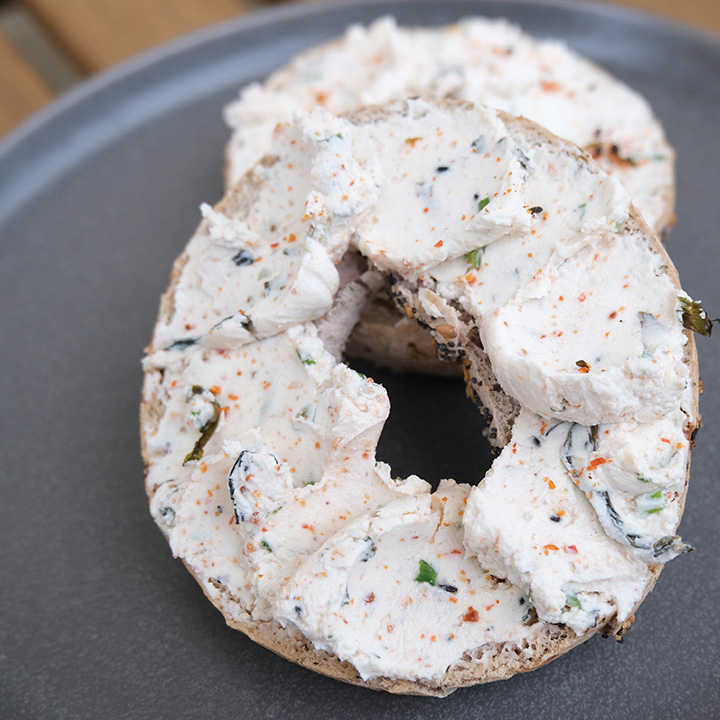
To prepare cream cheese
Combine all the ingredients in a bowl and use an electric mixer to beat on medium speed, then increase to high for 1-2 minutes. Scrape the sides as needed.
Serve on a toasted bagel, with crackers, on a charcuterie board, or with veggies.