Web cookies (also called HTTP cookies, browser cookies, or simply cookies) are small pieces of data that websites store on your device (computer, phone, etc.) through your web browser. They are used to remember information about you and your interactions with the site.
Purpose of Cookies:
Session Management:
Keeping you logged in
Remembering items in a shopping cart
Saving language or theme preferences
Personalization:
Tailoring content or ads based on your previous activity
Tracking & Analytics:
Monitoring browsing behavior for analytics or marketing purposes
Types of Cookies:
Session Cookies:
Temporary; deleted when you close your browser
Used for things like keeping you logged in during a single session
Persistent Cookies:
Stored on your device until they expire or are manually deleted
Used for remembering login credentials, settings, etc.
First-Party Cookies:
Set by the website you're visiting directly
Third-Party Cookies:
Set by other domains (usually advertisers) embedded in the website
Commonly used for tracking across multiple sites
Authentication cookies are a special type of web cookie used to identify and verify a user after they log in to a website or web application.
What They Do:
Once you log in to a site, the server creates an authentication cookie and sends it to your browser. This cookie:
Proves to the website that you're logged in
Prevents you from having to log in again on every page you visit
Can persist across sessions if you select "Remember me"
What's Inside an Authentication Cookie?
Typically, it contains:
A unique session ID (not your actual password)
Optional metadata (e.g., expiration time, security flags)
Analytics cookies are cookies used to collect data about how visitors interact with a website. Their primary purpose is to help website owners understand and improve user experience by analyzing things like:
How users navigate the site
Which pages are most/least visited
How long users stay on each page
What device, browser, or location the user is from
What They Track:
Some examples of data analytics cookies may collect:
Page views and time spent on pages
Click paths (how users move from page to page)
Bounce rate (users who leave without interacting)
User demographics (location, language, device)
Referring websites (how users arrived at the site)
Here’s how you can disable cookies in common browsers:
1. Google Chrome
Open Chrome and click the three vertical dots in the top-right corner.
Go to Settings > Privacy and security > Cookies and other site data.
Choose your preferred option:
Block all cookies (not recommended, can break most websites).
Block third-party cookies (can block ads and tracking cookies).
2. Mozilla Firefox
Open Firefox and click the three horizontal lines in the top-right corner.
Go to Settings > Privacy & Security.
Under the Enhanced Tracking Protection section, choose Strict to block most cookies or Custom to manually choose which cookies to block.
3. Safari
Open Safari and click Safari in the top-left corner of the screen.
Go to Preferences > Privacy.
Check Block all cookies to stop all cookies, or select options to block third-party cookies.
4. Microsoft Edge
Open Edge and click the three horizontal dots in the top-right corner.
Go to Settings > Privacy, search, and services > Cookies and site permissions.
Select your cookie settings from there, including blocking all cookies or blocking third-party cookies.
5. On Mobile (iOS/Android)
For Safari on iOS: Go to Settings > Safari > Privacy & Security > Block All Cookies.
For Chrome on Android: Open the app, tap the three dots, go to Settings > Privacy and security > Cookies.
Be Aware:
Disabling cookies can make your online experience more difficult. Some websites may not load properly, or you may be logged out frequently. Also, certain features may not work as expected.
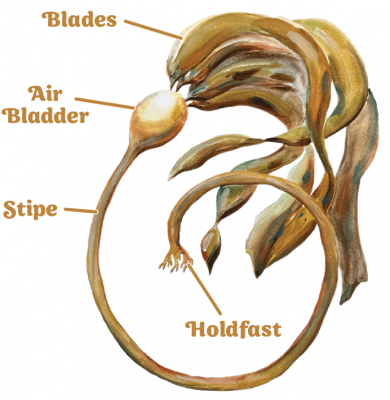
Bull kelp, whose scientific name aptly translates to “mermaid’s bladder,” grows in dense forests, often reaching 100 feet and growing up to two feet per day in warmer months. Found from Alaska to central California, it features a natural anchor called a “holdfast” to attach to rocks, a long hollow stipe, and a gas-filled bladder from which blades grow, forming the iconic kelp forest canopy.
For Pacific Northwest indigenous cultures, bull kelp is more than a seaweed – it’s a vital link between land and sea, human and supernatural. Historically, it was used for fishing, hunting, food preparation, and household items like ropes, baskets, and storage containers. Bull kelp is also featured in myths, stories, and children’s games, reflecting its cultural importance and the interdependence between indigenous peoples and the sea.
Since 2013, 90% of California’s bull kelp forests have disappeared due to warming ocean temperatures and an overabundance of kelp grazers like urchins. Further north in Washington and Alaska, bull kelp forests are healthy and thriving. Farming bull kelp helps reduce harvest pressure on wild kelp forests and provides opportunities for reforestation of this ocean majesty.
Flavor Profile (notes and cooking tips)
Clean, vegetal, and umami
Texture
Blades are tender, al dente, sticky, with a slight crunch. Stipe is thick and crunchy – similar to raw carrots
Preparation Tips
The blades, stipe, and air bladder of bull kelp have distinct textures, densities and cook times so it’s best to separate them using a sharp kitchen knife.
Rich in calcium, magnesium, sodium, iodine, potassium, bromine, phosphorus, iron, bulk fiber, vitamins A, B complex, C, D, E, and K.
Storage Tips
Separate stipe & blades before storing. Refrigerate and consume within 5 days of harvest. To prolong shelf life, freeze or dry in dehydrator and store
in a cool, dry place.
Environmental Benefits
Absorbs CO2 from the ocean and produces oxygen, shelters many commercially important fish, sea otters and invertebrates, and protects coastlines from erosion.
Equipment needed: 32 oz mason jar or multiple smaller jars
1″ – 12″ stipe of bull kelp
2/3 cup water
2 cups white vinegar
2 tsp sugar
4 tbsp pickling spice (or mix of mustard seed, celery seed, bay leaves, star anise, etc)
4 bay leaves
1 small onion
4 garlic cloves
lemon juice
Directions
Sterilize jars by boiling in hot water for 1 minute
Rinse bull kelp stipe in cold fresh water.
Peel the “skin” off the bull kelp stipe using a potato peeler.
Cut stipe and onion into ¼” rings, cut onion rings in half
Combine kelp rings and onion in a bowl, sprinkle with salt and mix together to draw out liquid, add ice and mix again, keep in bowl while processing the rest of the steps, up to 3 hours, depending on desired crispiness
Combine pickling brine- water, vinegar, sugar, spices- in a pot and bring to a boil for one minute.
Rinse salt soaked kelp and onions in freshwater and tightly pack into jar.
Pour hot pickling brine over top of the kelp and onion, cover with a sterile lid.
2 tbsp dried currants (soaked for 20-30 mins & drained)
2 tbsp pine nuts
1 tbsp dried mint
1 tbsp dried dill weed
1 tsp ground allspice
1 tsp ground cumin
15-20 blades of fresh or rehydrated bull kelp – cut to ~6” length
Directions
Prepare 1 cup of white rice al dente (~3-5 minutes less than fully cooked, you’ll be steaming this filling wrapped inside the Bull Kelp later).
Saute onion in olive oil until translucent.
Add chopped mushrooms and saute until fully cooked and golden brown.
Add al dente rice, tomato paste, currants, pine nuts, and seasoning and mix to combine.
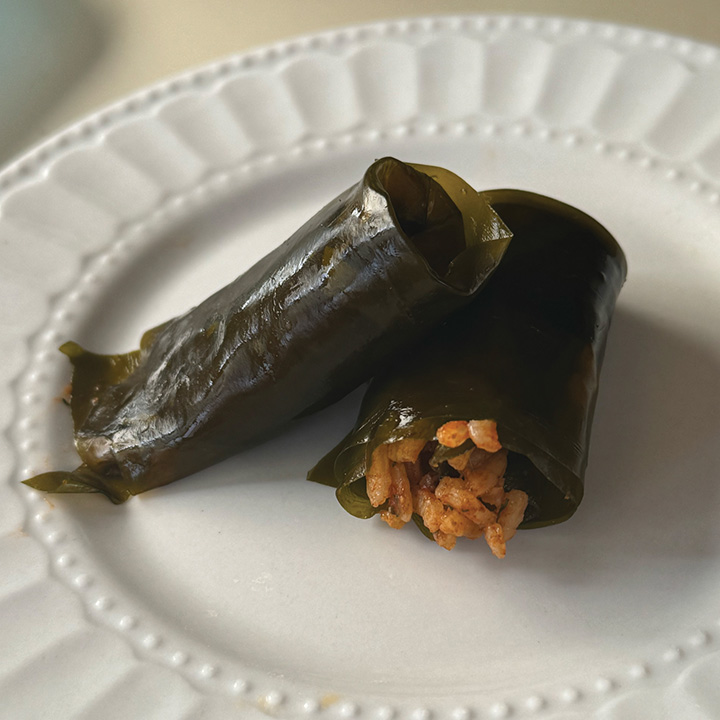
Lay blade of Bull Kelp out and add tbsp of rice mixture in center. Fold the sides over and roll like a cigar. Repeat until all filling and kelp blades have been used. The kelp will be slimy the longer you work with it, and rolling takes some practice and patience!
Prepare a pot with a steamer basket, place rolled dolma pieces inside and add water until bottom layer is just covered. Cover the pot and steam until bull kelp turns a vibrant bright green and rice is fully cooked (~3-5 mins). Remove from the steamer and serve.